You Cannot Give From an Empty Garden
Last week, I had the honour of listening to elders from Indigenous communities across the country speak about reconciliation in times of war and chaos. Much of their experience over the centuries has been just that, navigating their purpose in a world of constant change.
The central message they shared reminded me that peace and reconciliation start within ourselves. I often compare my lived experiences with tending my garden through the seasons.
Peace begins where we are standing. We sow the seeds to grow it in ourselves first, then extend it outward to our families, our communities, our country, our world.
A garden well tended produces more than one person can hold. It overflows into the hands of neighbours, strangers, and people we may never meet.
That is the nature of growing things. There is no world of love and peace if we are not looking for opportunities in our daily lives to cultivate it, starting with the small plot right in front of us.
Understanding Collective Grief and Vicarious Trauma
The last decade has been an experience of extremes. No one could have predicted a worldwide lockdown. Where we once found warmth and togetherness in the chaos, we seem to be on the other end of the spectrum. We are divided, and through social media, we’re more exposed to those divides than ever. We see more of what’s happening across the world, and have fewer resources to be able to help.
Think of it like a garden after years and years of relentless rain. The water does not just sit on the surface. It leaches nutrients from the soil slowly and steadily until the ground that once supported so much life can barely sustain itself.
The whole garden feels it, not equally, but collectively. Some plants wilt. Others bolt and go to seed too soon. A few hold on, but only just.
This is what collective grief and vicarious trauma look like. Collective grief settles over a whole community after catastrophic events like droughts, weather disasters, national tragedies, and wars.
With a 24-hour news cycle delivering loss after loss, it can take root even in people far from the source.
Vicarious trauma works differently. It seeps in through repeated exposure to other people's pain. We are constantly exposed to situations we cannot help on social media and in the news. Since 2020, I have seen both in almost everyone I work with.
The soil in our collective garden has been saturated for a long time now. The nutrients are diminished, and tending the garden takes more effort than ever.
Making a Decision to Tend the Garden Helps Us Move Forward
When we’re experiencing continual trauma, online and in our communities, our instinct is often to go small. We withdraw. We freeze. These are perfectly normal human responses to trauma.
A garden under stress does the same thing, pulling energy inward, dropping leaves, conserving what little it has left.
When everything feels big and overwhelming, hopelessness can set in. When we cannot see what we can do, it is easy to believe we cannot do anything at all.
But we can only tend the garden in front of us. That is where we start.
The 7 C's of Resilience offer a framework for doing exactly that. Developed by Dr. Ken Ginsburg, the 7 C's (Competence, Confidence, Connection, Character, Contribution, Coping, and Control) offer us a pathway to start working on our own resilience.
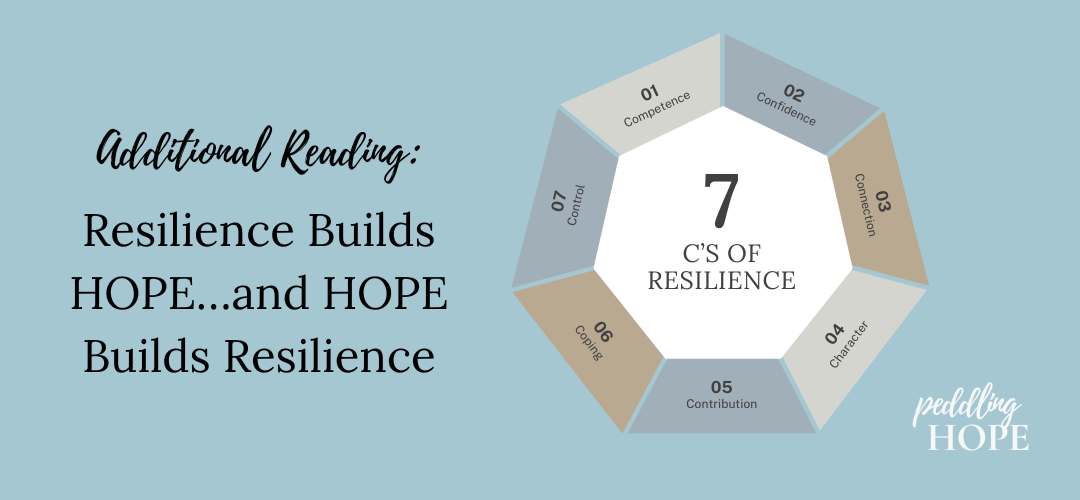
You cannot give from an empty garden, so it’s important to turn your intentions inward before overextending your resources to help. If you haven't read my post on the 7 C's, it's worth spending some time there. [Read it here.]
Building your village can build your resilience
Ask yourself: Where in my own garden can I begin? What do I already know how to do? Who is in my community, and how do I stay connected to them? Where do I have some control, even if it is small? What do my values tell me about who I am and how I want to show up?
These questions are part of the practice of tending your garden. And when you tend your garden (yourself, your home, your community), that care spreads outwards. And slowly and steadily, we all recover.
The more you tend to your own community, the more peace and love grow, and everyone has more to share. Science tells us that even witnessing an act of kindness shifts something in our physiology. Our nervous systems respond to goodness the same way they respond to threat, just in the opposite direction.
When we extend care outward, we are participating in something that restores the whole garden. Every small act becomes part of a larger harvest. That is how hope grows, not all at once, but steadily
Extending that nurturing to your community
There are so many beautiful things all around us that we can miss them in the noise.
Someone brought their baby to our lunch gathering last week. She had a sweet smile, and making eye contact with her warmed my heart. She is so innocent. I want her to experience a world of friendly faces that will build trust in her heart. That day, it was my face.
Something small that has a ripple effect out to the world. What else can we do to build a world of hope and healing?
1. Notice & Respond
What are the everyday things in your life that remind you that the world is filled with beauty? Our first act of service is to notice and respond.
Just as I responded to baby Sophi. It was not only a smile for her, but I made sure to let her dad know that I appreciated him bringing her.
Notice the barista or the cashier. Notice your partner. Let someone know they matter. It will strengthen the C's of community and connection.
2. Give Generously
Giving doesn’t just mean money. You could give your time. Although we may be short on both these days, a little can go a long way.
There was a time in my life when I really did not have a lot of either, so I gave blood. A little bit of time, but I may have saved a life. We can give without seeing the results of our giving.
The point is to be creative. Look for ways that you can contribute to your community and then give your whole heart to it. Imagine how far that would stretch if we each did a little bit every day.
3. Pick a Local Cause
This may be something you can pair with giving. Local is key. We need to be conscious consumers, especially these days.
Buying at our local farmers' markets, supporting local coffee shops and businesses, and volunteering with local organizations strengthen our communities.
If you are having a hard time knowing where to begin, perhaps consider one of the sustainability goals the UN has developed - areas of poverty and hunger, health and well-being, or peace and justice. It's not simply about going to a lecture, as I did when I listened to the elders speak about reconciliation. I then need to turn that information on truth and reconciliation into action.
4. Live in the real world
Of all the 7 C’s, Connection is the one most eroded by the world we live in now. Social media and AI-generated content have created a lot of noise that can leave us feeling lonelier than ever.
Unplug. It's OK. I took a social media fast at the beginning of the year and found far more room for real connection on the other side of it.
Put your phone down and do something with someone. Get a coffee. Go for a walk. Babysit for a busy parent. Walk a dog for an elderly neighbour. We all have needs. If you see one and respond, perhaps you'll find someone wanting to give back to you.
Reciprocity is the result of a world moving in the direction of service to one another.
5. Intentional Acts of Self-Care
Yes, self-care counts. You are a valuable part of the hope and healing for the future. That means, you need to take stock and look for an area in your own life where you can sow seeds.
Many areas need our attention: mental, emotional, and physical health. Self-care is not about a day at the spa, although those are pretty great. They can be about hydration and sleep, deep breathing and inspirational reading or listening.
Just pick one small thing and make a commitment to nurture that seed daily. Simple actions can go a long way to growing hope.
Although we may not be able to change the decisions of world leaders, we can change things in our own lives and in our communities by small, intentional acts of hope extended with love.
When you tend to your community and yourself, you have more to give. The harvest is much greater, and it becomes natural to pass on the abundance from the seeds you’ve sown.
It is what Mother Theresa advised so many years ago, "Not all of us can do great things. But we can do small things with great love."