Anxiety or Stress: What’s the difference?
These days, we hear a lot about anxiety. Most people are struggling with overload from a society that pushes being busy as if it were the goal of life itself.
We all have worries of some sort. Especially with all the dimensions of life we are juggling: career, home, kids, pets, and so much more. It’s bound to over-stress the system every once in a while.
What’s the difference between stress and anxiety?
First, we may want to consider what’s the same about them. Both stress and anxiety are emotional responses.
Stress, however, is typically caused by something external. Things like a deadline, a presentation, or exams. It is a situation that needs attention for resolution.
If stress goes on too long, it can cause short-term discomfort, such as difficulty sleeping, low energy, and intrusive thoughts. Our system is cataloguing the stress as dangerous, and it’s constantly scanning for a solution.
Anxiety, on the other hand, is an internal emotional response when the system is overloaded from feelings of stress and worry that do not resolve.
It runs the risk of long-term challenges to our mental, emotional, and physical health.
Anxiety is often felt more intensely. A few sleepless nights when you’re stressed about an upcoming presentation vs. insomnia caused by ongoing internalized anxiety.
How to identify which one you’re feeling
So, how do we distinguish what is happening in our bodies?
Is it limited in time?
First, ask yourself whether you're dealing with a time-limited situation that typically creates pressure as you resolve it.
When I worked at the university, students would often use the language of ‘anxiety’ and had a difficult time differentiating the typical stress of being a student.
For example, ‘anxiety’ over upcoming exams would be a type of stress, so long as the ‘anxiety’ is alleviated when the exams are over.
Is it resolvable?
Next, you may want to consider if there is something you can do to alleviate some of the stress.
Students may ask for extensions on papers or work in study groups, for example.
A disagreement with your partner may be resolved more quickly by talking through the issue at hand.
Even ‘good’ stress, like planning a wedding or a big party, may ease with task delegation.
Coping strategies can help, too: breaking tasks into smaller, more manageable bits, reorganizing the timeline, and interrupting unhelpful thoughts that creep in. (Side note: We can use a system for that by asking: Is this a thought that needs attention, or is it a fear that is not helpful to consider right now?)
Does it have a specific trigger?
Anxiety is different because it does not always have a trigger. It could be that a prolonged period of stress has shifted the system into a constant state of fear.
Everything is being filtered as a potential threat. Even if you know, intellectually, that you are not in danger, and your body is just not listening.
While stress and anxiety often feel the same, something with a specific trigger (i.e. upcoming exams) is likely stress. Where feeling anxious/stressed about the idea of going to class for months at a time would more likely be anxiety.
If all external situations that cause feelings of stress/anxiety have resolved, and the feeling persists, it is more likely being felt internally.
The symptoms are often the same, so it’s important to identify which you’re experiencing if you want to work toward a resolution.
Symptoms of a Stress State
Stress has various symptoms and feels a little different to everyone.
A stress state can have physical symptoms like:
Dizziness
Headaches
Heart palpations
Decreased breath capacity
Digestive issues
Change in appetite
Change in weight
Low energy
General feelings of being unwell.
A stress state can also have emotional symptoms:
Feeling like crying frequently
Bursts of anger or irritation
Self-isolation
Feeling like a burden
General emotional dysregulation - feeling like you’re not at your best or even at your ‘normal’
Mental symptoms of a stress state:
Difficulty holding a conversation
Brain fog
Hyper-focusing
Wandering thoughts
Intrusive thoughts
Lack of problem-solving
Whether it is stress or anxiety, your system is poised to run away from danger. Everyone has a built-in program that tells them what to do in that moment - run (flight), withdraw (fawn/freeze), or fight.
Both ‘stress’ and ‘anxiety’ are forms of stress state, so the symptoms can overlap significantly.
How Anxiety Stands Out
It’s difficult to pull anxiety and stress apart because the symptoms can overlap in most cases; however, you KNOW it’s anxiety if it comes with a ‘sense of doom’ or ‘overwhelming sense of dread.’
Because stress is external, has a specific trigger and can be resolved, it does not create a sense of dread.
Anxiety, however, has been experiencing an increase in reporting since 2020. It seems that a global pandemic and the response to it gave us a glimpse into a new possibility that we may not have considered before.
There were symptoms of stress being felt at every turn: working from home, homeschooling, shots (or no shots), and a general uncertainty about how to handle health concerns.
It changed a lot of our day-to-day activities. And we always had to watch the news for the most up-to-date protocols.
Everyone has a story about how a milestone was affected: graduations and proms, weddings and other gatherings, developmental milestones for littles. It has caused a lot of stress overload.
How to make our way back from Anxiety
Anxiety is more common after a long period of upheaval. How do we get our systems back into a state of calm?
The first step is helping your body to remember what a state of calm feels like. Focused breathing, slow stretching, drinking water and limiting stimulants help the body remember what it feels like to be safe.
These are daily self-care practices that should be done every day to help the body feel it can count on these safe pockets of the day. To reset your feeling of ‘normal.’
Anxiety is characterized by ongoing stress, so while it would be ideal to take a 3-month break and go on a retreat to a beautiful desert island to give the body the reset it needs, it’s not realistic.
Instead, commit to simple, daily healing rituals that help your body find moments of peace, even during stressful situations.
Is it Urgent? Is it Important?
If you are managing anxiety, you’ll need a number of tools to help you get back to a new normal. I share posts every Sunday giving you small self-care exercises you can add to your toolbox (so make sure you follow along on Facebook or Instagram), the first step is making time for these small self-care rituals until they become second nature.
Another tool I like to use is the Four Quadrants.
Stephen Covey’s Four Quadrants is one of my favourite tools for deciding where I need to spend more time and where I need to pay attention to the things that are stressing me out. All of our daily tasks end up in one of the quadrants.
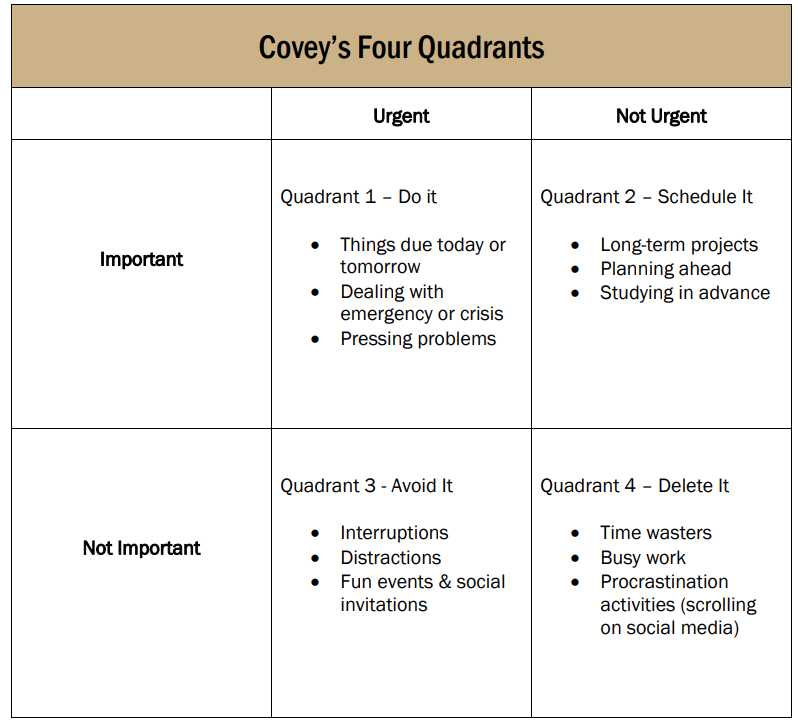
The daily rituals I’m asking you to add to your life are important. Really important. But they are not urgent.
Most of the things that are good for us land in this quadrant. It is the time we need to spend with our family and friends, the meal planning we need to do to ensure good nutrition, and it is the time in nature to reset our system.
These are the things that can cause issues in the long run if we don't pay attention to them in the short term. These are the things we need to do to reset our stress levels, address symptoms of stressors in our lives, and recover from burnout.
They are important. Vital even. But they are not urgent.
Our time can be dominated by things in the 4th quadrant that feel good in the moment. These are things that are neither urgent nor important: getting wrapped up in non-urgent emails, watching TV for hours, and doomscrolling on our phones.
While these things may feel good at the time, they do not contribute to relieving stress and anxiety.
If you can focus the extra time you have outside the First Quadrant on self-care, rather than time-wasters, you will be better able to tackle stress when it comes up before it turns into long-term anxiety.
For example, I’ve recently gotten into paint-by-numbers via an app on my phone. While I wouldn’t consider it something urgent, I do think it’s important to find creative ways to relax. Generally, any activity that uses your hands and gives you a break from screens will benefit your mental health in the long term. So try it out! You might be surprised how much you enjoy it.
Here is a downloadable PDF to set up your own quadrants exercise.
Making a plan to move forward
If you realize that you are experiencing anxiety, it’s important to talk to your health care provider. You may need medication for a time and/or a good therapist.
Professionals who work with the body are also a great resource for reducing anxiety, such as massage therapists, osteopaths, and physiotherapists.
If your life is particularly stressful, take all the tasks you are currently responsible for and put them individually on sticky notes. See if you can put them in one of the four quadrants:
Urgent/Important
Not Urgent/Important
Urgent/Not Important
Not Urgent/Not Important
There may be things that you can take off your plate today just by reprioritizing.
See if you can add a few 1-minute breaks to the Not Urgent but Important Quadrants: a water bottle for more hydration throughout the day, a stretch and a few deep breaths each time you use the bathroom, and an affirmation to help you stay present.
If worry thoughts intrude, ask yourself: Is there anything I can do to move this forward right now? If not, practice imagining you are setting that worry aside for the time being.
Remember, you are not alone. We all have times of stress, and our system can get overwhelmed.
We all need a village around us for support and ideas for coping. It’s up to us to build that village. Spend time with people in your life who support you. Find online spaces (like this one) that encourage. Limit the amount of news coming in.
Our systems can only handle so much each day. This is a one-day-at-a-time journey. Today, you breathed. Tomorrow, pay attention to your breath a couple of times through the day.